
Enterprise architecture is often viewed as a collection of diagrams describing systems, servers, and technologies, while data is treated as a separate responsibility assigned to another department or function.
Institutional reality, however, demonstrates that enterprise architecture and data cannot be separated. Each complements the other and provides the operational context required to create value. Enterprise architecture answers the question, “How does the organization operate?” while data answers, “What does the organization operate on?”
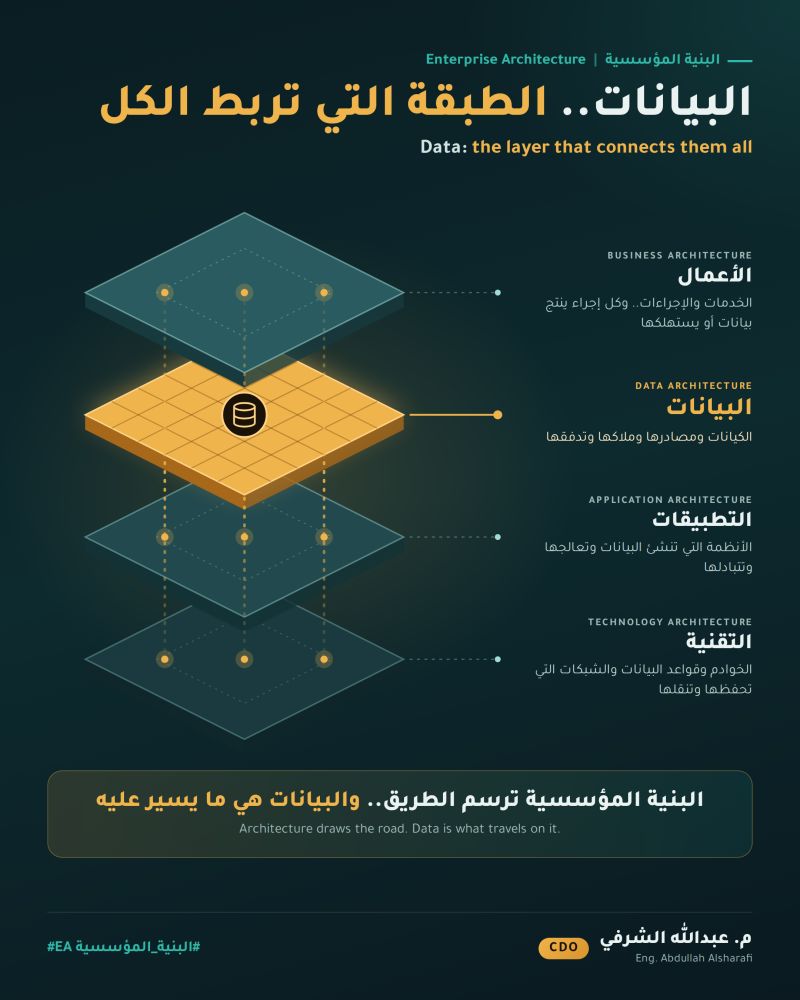
An integrated institutional view consists of several interconnected layers:
- Business: This includes services, procedures, and processes, each of which either produces or consumes data.
- Data: This includes data entities, sources, owners, and the mechanisms through which data flows between systems and processes.
- Applications: These are the systems that create, process, or exchange data.
- Technology: This includes the infrastructure—servers, databases, and networks—that supports data storage and transfer and enables systems to operate.
When data is not treated as a core component of enterprise architecture design, several challenges begin to emerge. Multiple systems may store the same information with conflicting values, separate integrations may be developed for individual needs, or new systems may be launched without clearly identifying the authoritative source of data.
When data is properly integrated into enterprise architecture, the overall picture becomes clearer. The authoritative source for each data entity can be identified, the role of every system throughout the data lifecycle can be defined, and integrations can be designed more efficiently and for greater reuse.
This changes the question organizations should ask when considering a new digital system or project.
Instead of beginning with:
What system do we need?
Organizations should begin with questions that are more closely connected to data, such as:
What data will this system create? Who owns it? What is its authoritative source? Who will use it? How will it move between systems?
This shift in thinking helps reduce duplication, improve data quality and integration, and support institutional decisions based on more reliable information.
Data then becomes more than an output of systems; it becomes a fundamental element in the design of the enterprise architecture itself.
Enterprise architecture maps the road, and data is what travels along it.
To view the original post and learn more on LinkedIn:
https://lnkd.in/p/dxerHGk4
Source: A LinkedIn post by Eng. Abdullah Al-Sharafi.