
Organizations process various types of personal data every day, including names, national identification numbers, mobile phone numbers, academic and health records, and other information directly or indirectly associated with individuals.
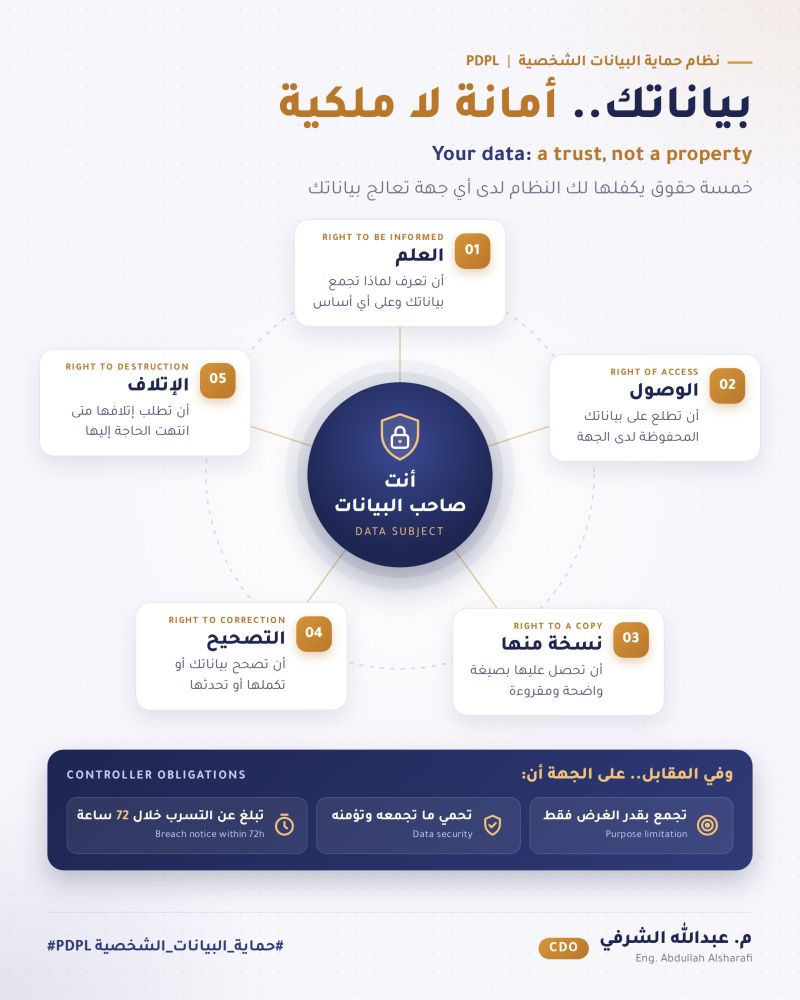
This data remains a trust entrusted to the organization that collects and processes it; it does not become the organization’s absolute property. Saudi Arabia’s Personal Data Protection Law grants data subjects a set of fundamental rights.
These rights include:
- The right to be informed: Individuals have the right to know why their data is being collected, the legal basis for its collection, and the parties that may access it.
- The right of access: Individuals may access the personal data held about them by the organization.
- The right to obtain a copy: Individuals may request a clear and readable copy of their personal data.
- The right to correction: Individuals may request that their data be corrected, completed, or updated when necessary.
- The right to destruction: Individuals may request the destruction of their data when there is no longer a legal or operational need to retain it.
Organizations, in turn, bear significant responsibility for handling personal data. This responsibility begins with collecting only the amount necessary to achieve a specified purpose, continues through its protection and security, and extends to the proper management of any incidents involving it.
One of the most important principles of personal data protection is that effective compliance does not begin after data has been collected. It begins earlier, by asking a fundamental question when designing any new form, system, or service:
Do we genuinely need to collect this data?
The less unnecessary data an organization collects, the lower the risks associated with protecting, managing, and retaining it, and the more efficiently it can meet privacy and compliance requirements.
One of the best practices in personal data protection can therefore be summarized in a simple principle:
The best protection for personal data begins by not collecting data for which there is no genuine need.
To view the original post and learn more on LinkedIn:
https://lnkd.in/p/dM_9Fp5q
Source: A LinkedIn post by Eng. Abdullah Al-Sharafi.