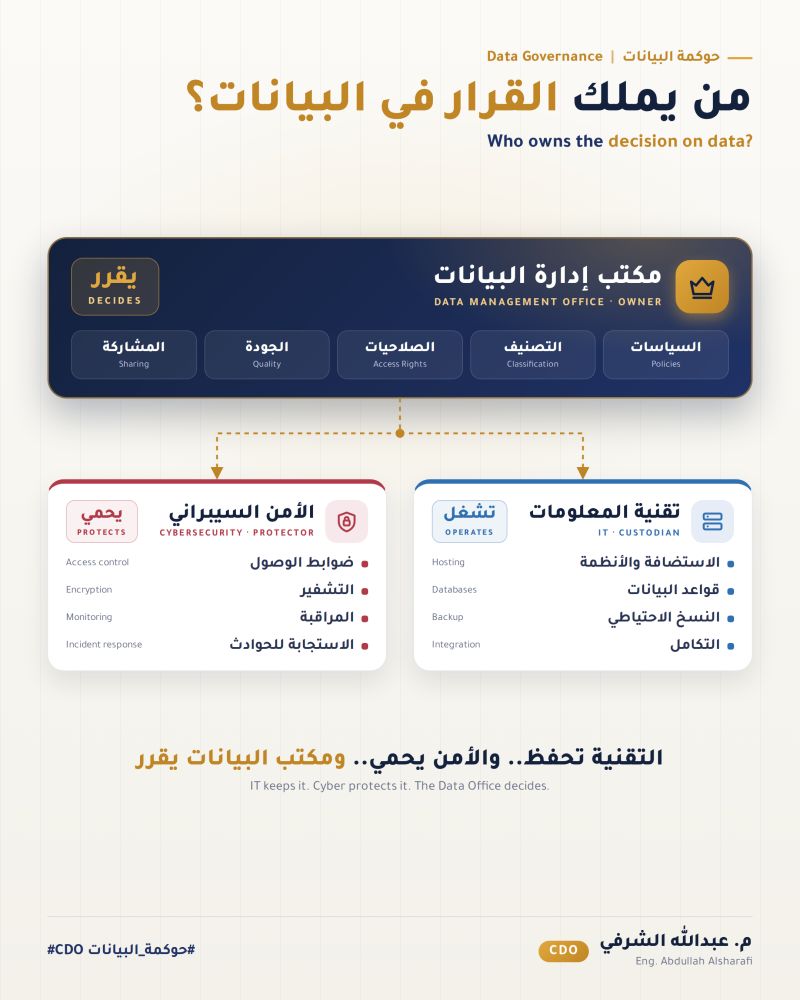

Data governance within organizations requires a precise and clearly defined distribution of roles and responsibilities among the Data Office, Information Technology, and Cybersecurity. Effective governance does not depend on a single entity; it requires these parties to work together within a clear institutional framework.
The National Data Management Office standards identify the Data Office as the authoritative reference for governing an organization’s data, while Information Technology and Cybersecurity perform complementary roles in implementation and protection.
This integration can be summarized through three primary roles:
- The Data Office decides: It establishes policies, determines data classifications, regulates access rights, monitors data quality, and governs data-sharing mechanisms.
- Information Technology operates: It manages systems, databases, technical infrastructure, backups, and operational continuity.
- Cybersecurity protects: It applies access controls, encryption, and monitoring measures and mitigates risks associated with unauthorized access.
An employee record provides a practical example of how these roles interact:
The Data Office determines the record’s classification, who is authorized to access it, the purpose for which it may be used, and the requirements governing its handling.
Information Technology hosts the record within the appropriate systems and databases and operates the technical environment required to store it and make it available for authorized use.
Cybersecurity protects access to the record, monitors related activities, and applies the appropriate technical safeguards.
This separation of responsibilities does not mean that each entity operates independently. Its true value emerges when all responsibilities are integrated within a clearly defined governance model.
Without the Data Office, systems may function technically without clear rules governing the data they contain.
Without Information Technology, the operational environment required to implement those rules would not exist.
Without Cybersecurity, data could be exposed to unauthorized access or use.
Institutional maturity in data management therefore depends on answering a simple question:
Who decides, who implements, and who protects?
The relationship among these entities can be summarized in one concise statement:
Information Technology stores, Cybersecurity protects, and the Data Office decides.
To view the original post and learn more on LinkedIn:
https://lnkd.in/p/d44p3ixc
Source: A LinkedIn post by Eng. Abdullah Al-Sharafi.